

I saw "Wuthering Heights" and I liked it...
Sunday Blog 225 - 8th March 2026

[With apologies for the ear worm I've planted]
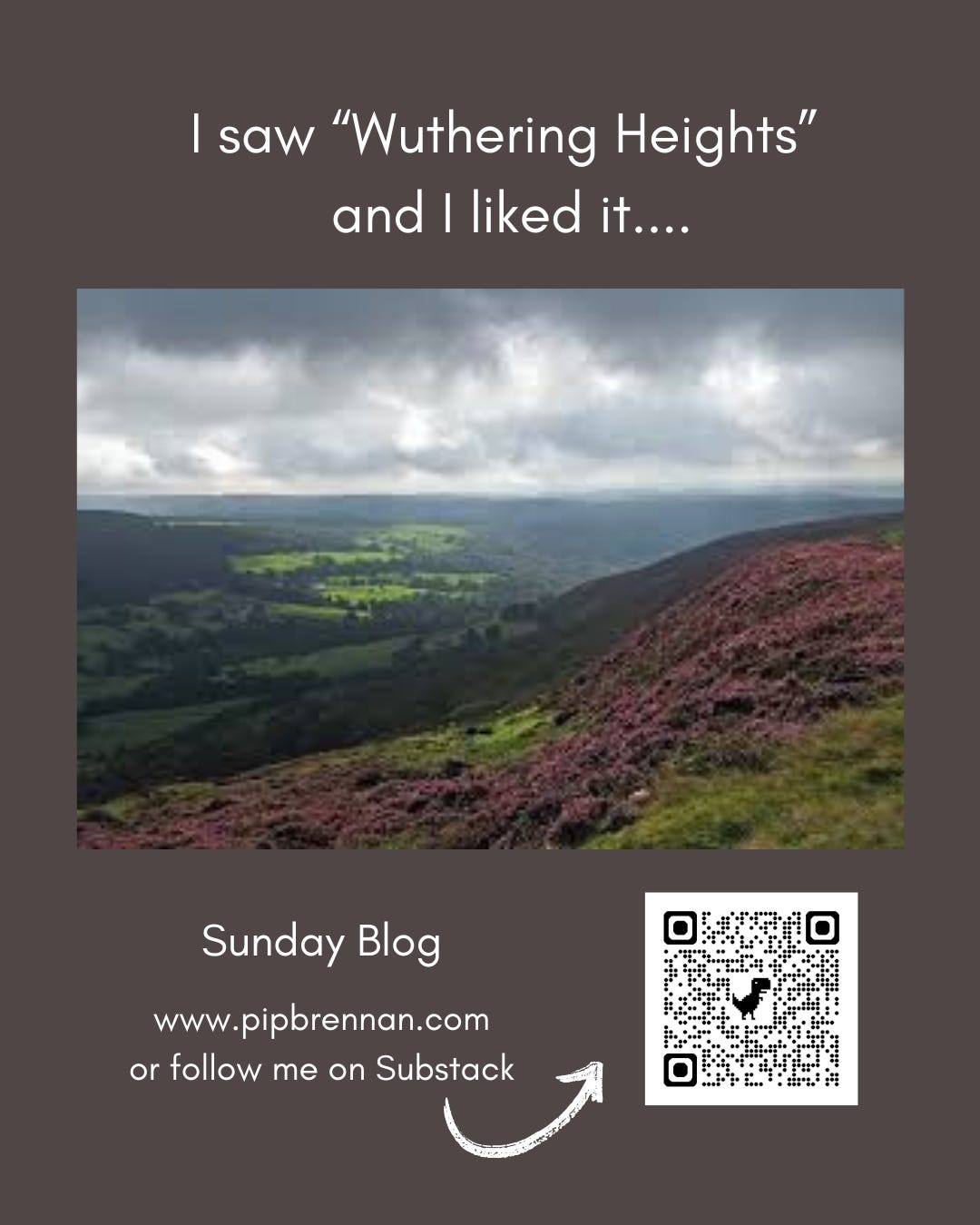
Like many youngest children of large families, I read books when perhaps I was too young to fully comprehend them.
Wuthering Heights was one such book. I can’t count the number of times I read it as a teen, stumbling through the Yorkshire dialect and trying to visualise the dark, powerful moors and dysfunctional households. Bit by bit I made more sense of it the book.
I studied Literature in High School and still recall the long, ranty essay I wrote to refute the notion that Wuthering Heights as a book dies when Catherine does. With passion I asserted that the second half of the book was every bit as good as the first. “Your essay is as wild as the moors you are writing about,” was one comment from the teacher, but any criticism of Wuthering Heights at the time generated a vociferous, if incoherent defence.
I continued to re-read the book as I matured, and eventually formed the view that there’s something wild and unformed about Emily Brontë’s only published work that has adolescent appeal. That it is better to read it while still on the cusp of adulthood as I did, to appreciate it. Otherwise it may come off as shrill and histrionic.
All this to say, I enjoyed the 2026 “Wuthering Heights” movie adaptation as a creative riff on a classic work. For me it was satisfying to end the movie when Catherine died, and to utilise the lush possibilities of sets and costumes to consummate the desperately unhealthy connection between Catherine and Heathcliff. The movie passes beyond the worldly experience Emily Brontë had and weaves its way to modern times with the Yorkshire moors still as the star of the show. As they should be.
As least, that’s how I experienced it.