

Reflections on War
Sunday Blog 231 - 26th April 2026

This weekend in Australia we commemorated Anzac Day, and all Australians and New Zealanders who served in wars. I reworked this piece from last year I’d written on Remembrance Day, and as usual you can read or listen as you choose. It’s a bit longer than normal. 4.44. I think that’s a sign from Geordie.
November 11, Remembrance Day 2025. I’m at Perth airport on my way to Melbourne for a meeting. The incessant cacophony of plane announcements is interrupted just before 11am. A recorded voice breaks out with The Ode.
At the going down of the sun and in the morning, we will remember them.
The bugle refrain lasts long enough to tempt me to snicker at its cartoonish, slightly off-key quality, but then the minute’s silence falls. The uncanny quiet of the terminal grips me in the throat, the heart, the gut. All I can see is the image of my grandfather, Mum’s dad Geordie, at 17, in his World War One uniform. He’d lied about his age, succumbed to the relentless pressure and promise of adventure and had signed up for the slaughter of battle.
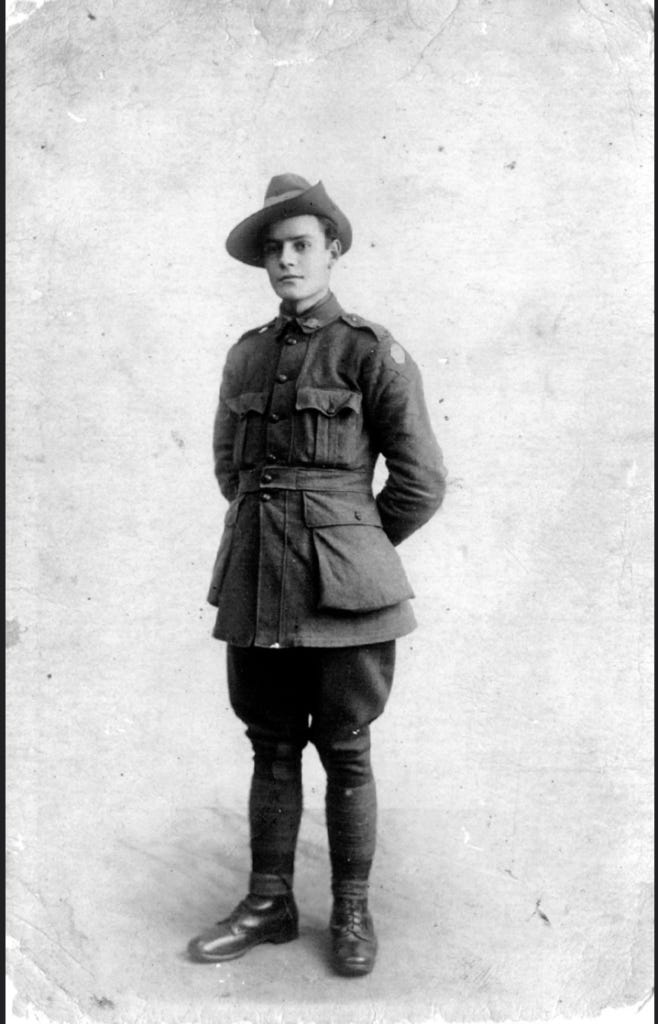
Wilfred George (Geordie) Mulligan
I grew up with this photo of Geordie. It fought for space with the jumble of framed ancestors Mum had coated every cluttered bookshelf, mantelpiece and wall space with. After six decades, this photo, among the vast avalanche of all the things that were emptied from Mum’s home, has ended up at my house to be part of my daily life.
His uniform portrait, full length. The puttees bandaging his calves. The coat flaring at the hips. His very handsome face underneath the slouched hat. He’ll be shipped from Sydney to Egypt and Gallipoli, wounded in August 1915 and returned to Australia to heal. And back again, this time to France. He’ll be wounded again in September 1917 but back on duty by April 1918, where he’ll be taken as a prisoner of war in German hands. He’ll be rescued, taken back to England by November 1918 but won’t be repatriated until April 1919. Too emaciated to ship back earlier.
‘I didn’t cry the first time I went away, but I sure cried the second,’ he was known to say. Every Anzac Day, every Remembrance Day, his memory inspires me to say, ‘Lest we forget the horrors of war.’
At the airport, my throat feels like I’ve swallowed a mint whole. My eyes sting with unshed tears, and my heart swells with the piercing melancholy of everything passing. This reaction to Remembrance Day catches me off guard, like I’ve glimpsed the double of a long-ago, long-dead lover in the street. As if the death of Mum one year ago has thrust me into the front line of mourning, of holding remembrance.
I never met Geordie. He died aged 65, nearly three years before I was born. He was a handsome child, ‘the nicest boy in Rivervale’ as he was known. He’d met Essie, my grandmother, while they were still at school.
When he was back in Perth in 1915, healing from his first war injury, he’d re-connected with Essie. When he went back to France, she gave him this photo to hold close during the next round of suffering.
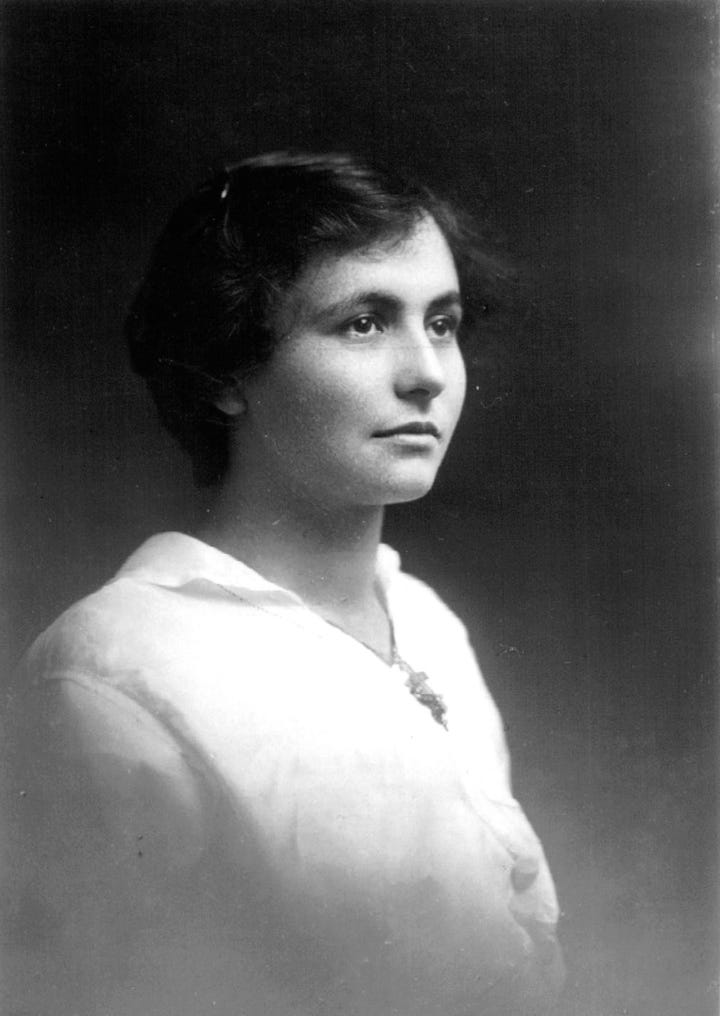
Esther Florida Northey in 1916 in Perth
Yes, Geordie made it back after the war, but parts of the nicest boy in Rivervale were blasted clean for good.
And on this day in 2025, at the airport, this loss of Geordie’s essence gripped me with the raw freshness of a new grief, rather than a tragedy of more than a century ago. Do we have an Ode to crushed mental wellbeing? When the body survives to grind through the decades, battling the permanent chafe of the battlefield grit?
Lest we forget. Lest we forget the horror of war.